
It is a people-focused, target-driven profession combining research, business understanding, judgment, persistence, relationship management, and the ability to handle rejection.
It can offer excellent learning, career growth, industry exposure, and earning opportunities. But it can also involve pressure, changing priorities, unanswered calls, candidate dropouts, difficult conversations, and positions that close after days of effort.
So, before choosing recruitment as your career, do not ask only:
"Can I become a recruiter?"
Ask yourself:
"Does the real work of recruitment match how I like to work?"
Let us help you find out.
What Does a Recruiter Actually Do?
A recruiter helps an organization identify, attract, evaluate, and hire the right people. That may sound straightforward, but several activities take place before a candidate finally joins an organization.
A recruiter may be responsible for:
- Understanding job requirements
- Separating mandatory skills from preferred skills
- Researching industries, companies, roles, and talent markets
- Searching for candidates through LinkedIn, job portals, databases, referrals, and professional communities
- Creating Boolean and keyword searches
- Reviewing resumes
- Conducting initial screening calls
- Evaluating experience, skills, motivation, salary expectations, and availability
- Coordinating interviews
- Collecting and communicating feedback
- Negotiating or supporting job offers
- Following up with candidates until they join
- Maintaining recruitment records and reports
- Building relationships with candidates and hiring managers
Recruitment sits at the intersection of people and business. You are helping someone make an important career decision while helping an organization solve a business problem.
A Day in Recruitment
Your 9-to-5 might look like:
8:30 AM – Email check. Review candidate messages, hiring manager feedback, and job board notifications. Update spreadsheets. Initial outreach to 5–10 prospects.
10:00 AM – First screening call with a candidate. 30 minutes. Questions about experience, motivation, expectations, and availability. Make notes.
11:00 AM – Follow-up email to hiring manager about yesterday's interview. Review resume from candidate who applied overnight. Reject 3 candidates who don't match requirements.
1:00 PM – Lunch break.
2:00 PM – LinkedIn research. Search for passive candidates. Create Boolean search strings. Save profiles. Send customized connection requests.
3:30 PM – Meeting with hiring manager. Discuss open roles, feedback on recent candidates, salary bands, and interview schedule.
4:30 PM – Third round interview call. Candidate asks questions. You answer and probe deeper. Candidate seems interested but wants to think about the offer.
5:15 PM – Update records. Send interview feedback to hiring team. Reach out to 2 more candidates for next week. Check messages one more time.
5:45 PM – Plan tomorrow. Make follow-up call list. Review pending offers.
7 Signs Recruitment Could Be Right for You
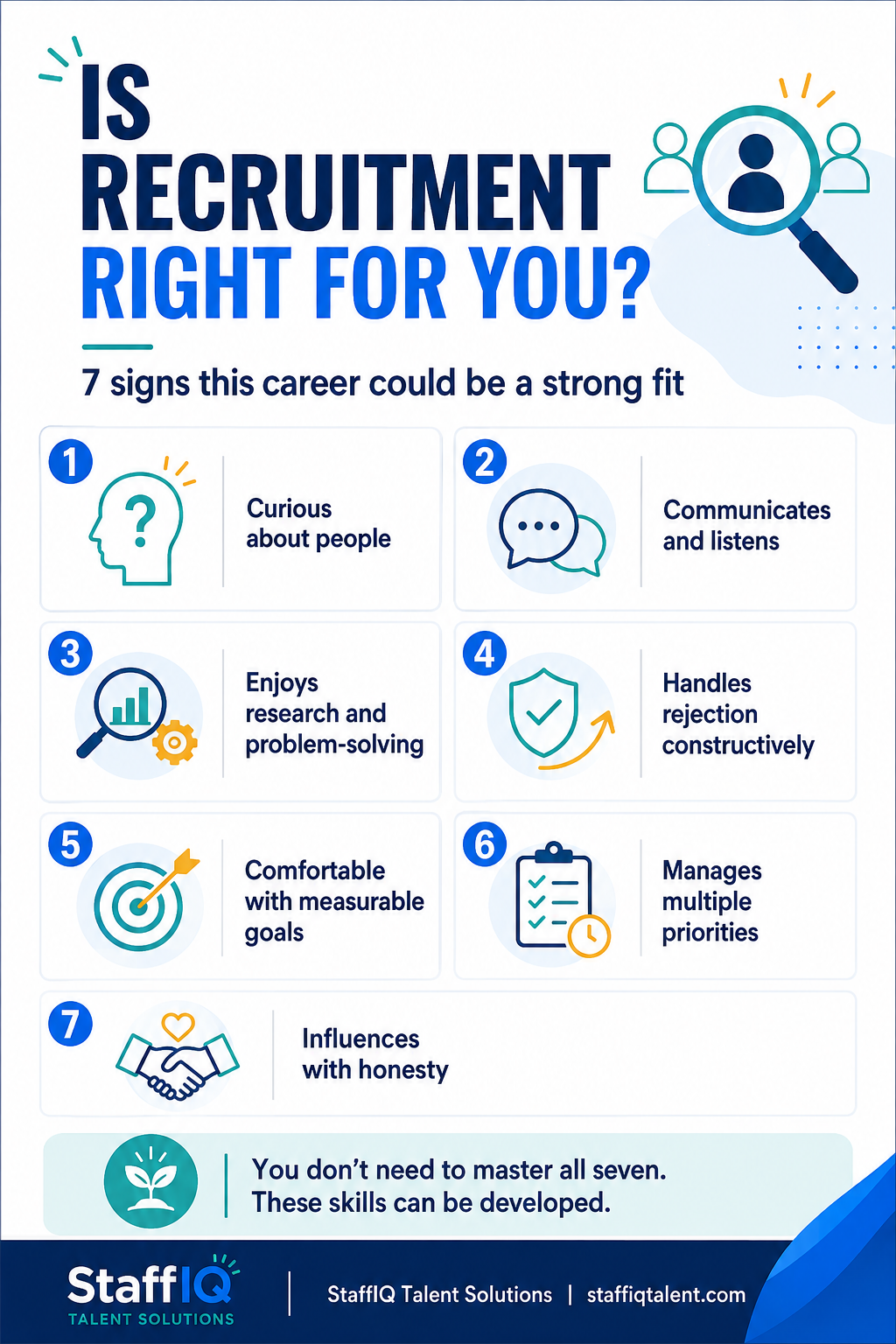
1. You Enjoy Conversations More Than Emails
You like talking to people, asking questions, and understanding what matters to them. Written updates feel lonely. You prefer to build relationships face-to-face or over calls.
2. You Thrive Under Variable Targets
You don't need certainty to stay motivated. You actually prefer roles where success depends on what you do today, this week, and this month—not just what you did last year.
3. Rejection Doesn't Derail You
Candidates say no. Hiring managers reject candidates you believed in. Job orders close. Offers fall through. You see each as information, not failure. You move forward.
4. You're Genuinely Curious About People
You want to know why someone left their last role. What they actually want from their career. Why they hesitated on that offer. You ask follow-up questions naturally.
5. You Like Solving Puzzles
A hiring manager describes a role in vague terms. You ask clarifying questions until the role is clear. Then you search for someone who fits. The hunt itself keeps you engaged.
6. You're Comfortable With Ambiguity
Priorities shift weekly. A role's requirements change mid-search. A candidate you matched perfectly flakes out. You adjust and move on without frustration.
7. You're Willing to Work Hard for Long-Term Relationships
You know that today's "not now" candidate becomes tomorrow's perfect fit. You stay in touch with candidates for months or years. You see each placement as the beginning of a relationship, not the end.
Recruitment May Not Suit You If…
- You need to see immediate, measurable impact from your effort
- You prefer structured, predictable workflows
- You're easily discouraged by "no"
- You avoid difficult conversations
- You prefer working alone
- You need clear metrics for success
- You're uncomfortable with sales
- You prefer technical work to people work
Common Myths About Recruitment
Myth 1: "All recruiters do is post jobs and wait for applications"
Reality: Application screening is maybe 20% of recruitment. Most of your work is research, outreach, relationship building, and follow-up.
Myth 2: "Recruitment is easy—it's not a real skill"
Reality: Recruiting is a taught skill. Good recruiters understand job markets, candidate psychology, salary negotiation, resume translation, and hiring manager communication.
Myth 3: "Recruiters only care about commissions"
Reality: Many recruiters care deeply about good placements, candidate fit, and building reputation.
Myth 4: "You need an HR degree to be a recruiter"
Reality: Most great recruiters come from non-HR backgrounds. What matters is curiosity, work ethic, and communication skills.
Myth 5: "Recruitment jobs are all the same"
Reality: Corporate recruiting, agency recruiting, IT staffing, executive search, and talent sourcing are dramatically different roles.
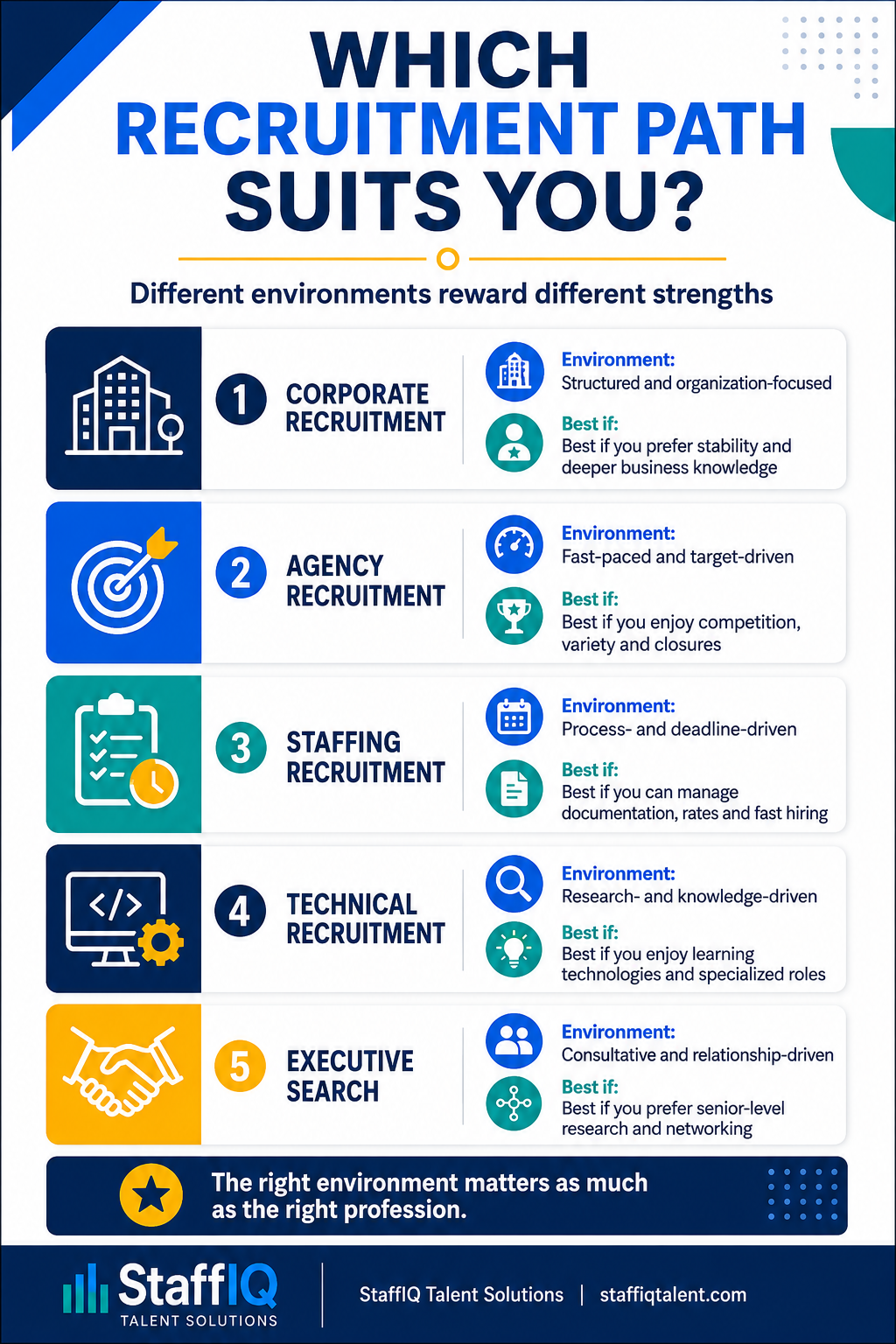
Not Every Recruitment Job Is the Same
Corporate Recruitment
Setting: You work for one company, filling their open positions.
Pros: Stability. Single culture to learn. Long-term relationships with hiring managers. Strategic involvement in workforce planning.
Cons: Limited positions to fill. Slower pace. Less exposure to different industries.
Agency Recruitment
Setting: You work for a staffing firm, placing candidates across multiple client companies.
Pros: Exposure to many roles and industries. Faster paced. Direct link between effort and commission. Rapid learning.
Cons: Higher pressure. Constant client management. Less stability. Quick client churn.
IT Staffing
Setting: Specialized recruitment for technology roles, often involving visa sponsorship and multi-month placements.
Pros: High fees. Clear specialization. Growing market. Good earning potential.
Cons: Requires understanding of visa categories and tech stacks. Longer sales cycles.
Technical Recruitment
Setting: You recruit for technical roles, often requiring product engineering knowledge.
Pros: Higher salaries. Strong network. Clear technical screening ability.
Cons: Requires learning technical concepts. Candidate pool is smaller and more competitive.
Executive Search
Setting: You fill director and C-suite roles through research and relationship work.
Pros: High commissions. Prestigious. Relationship-driven. Requires fewer placements.
Cons: Very long sales cycles. Fewer placements per year. Requires existing network.
Do You Need an HR Degree?
The honest answer: No.
An HR degree can help, but it is not a requirement. Most recruiters in US IT staffing come from diverse backgrounds: sales, customer service, tech, operations, and liberal arts.
What actually matters:
- Communication skills
- Work ethic
- Curiosity
- Responsibility
- Learning willingness
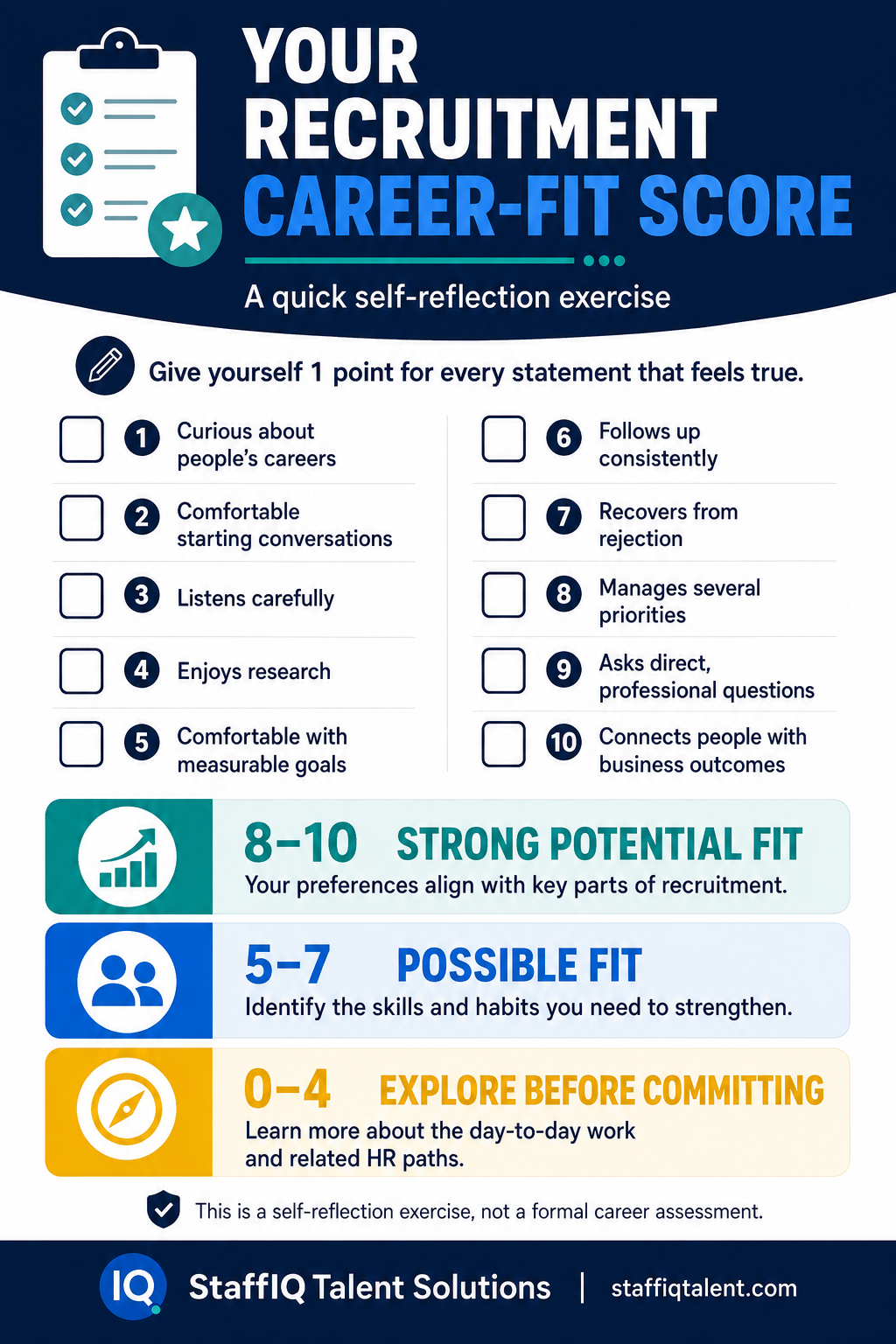
Quick Self-Assessment
Answer these 10 questions. Give yourself 1 point for each "yes."
- Do you enjoy talking to strangers and asking them about their career goals?
- Can you handle rejection without taking it personally?
- Do you prefer roles with variable outcomes over predictable routines?
- Are you comfortable with ambiguity and changing priorities?
- Do you have the patience to follow up with people for weeks or months?
- Can you communicate complex ideas in simple terms?
- Do you actually care about matching people to jobs they'll enjoy?
- Are you willing to learn new skills on the job?
- Do you see problems as puzzles to solve?
- Can you maintain optimism and energy even when closing rates are low?
Scoring:
- 8–10 points: Recruitment could genuinely suit you.
- 5–7 points: You have the right qualities, but success will depend on the specific role and organization.
- 0–4 points: Recruitment may create stress. Consider targeted skill-building or mentorship first.
The Difficult Side
Honesty demands we mention what recruitment can really be like.
The pressure is real. If you're agency-based or on commission, slow weeks are financially stressful. Hiring managers expect results. Candidates expect responsiveness.
People will disappoint you. A candidate you spent weeks nurturing accepts an offer, then withdraws. A hiring manager changes the job requirements mid-search. Your favorite candidate bombs the interview.
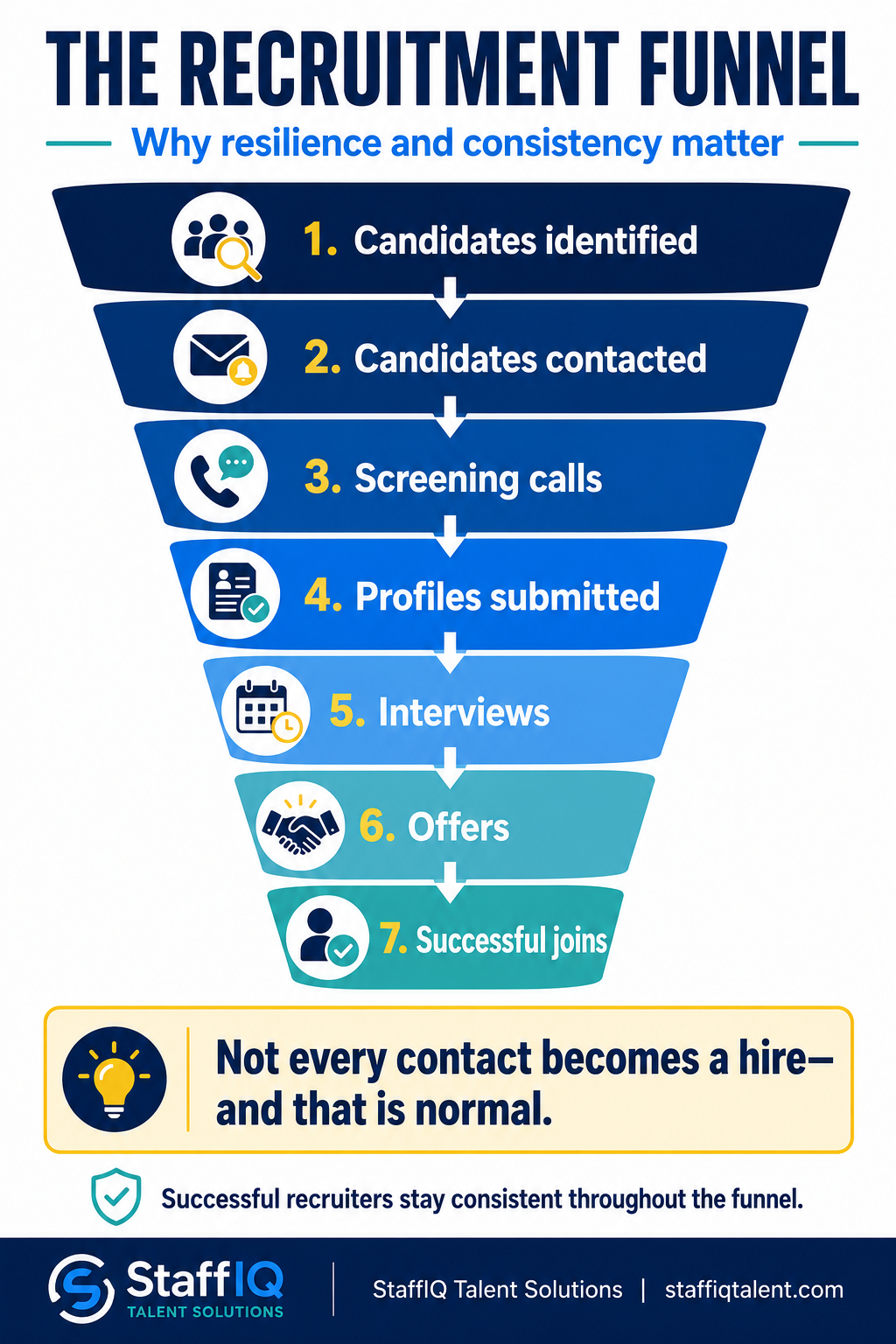
You will hear "no" more than "yes." Most people don't respond to outreach. Most candidates don't make it past screening. Most interviews don't lead to offers. You need resilience.
Admin work is inescapable. Despite all the software, spreadsheets, emails, and status updates consume time.
The work can be isolating. Despite being people-focused, recruitment can be lonely. You live in the gaps between people's decisions.
What Makes Recruitment Rewarding
You change people's lives. A job placement is not just an event. It's often a turning point. Someone leaves a role they hated. Starts a new career. Relocates. Gets a significant raise. And you were the person who made that possible.
You build genuine relationships. After recruiting someone, you stay in touch. You meet them for coffee a year later. Candidates refer friends. Hiring managers trust your judgment.
You learn constantly. You'll learn about dozens of industries, companies, roles, and skill areas. You'll understand job markets in ways most people never do.
You can earn well. Especially in US IT staffing, recruitment offers genuine earning potential. Commission structures can be generous. Career progression is fast.
You have control. Unlike many jobs, your results are yours. If you work hard, learn the market, build relationships, and close placements—your income and career progression reflect that directly.
Try Recruitment Before You Commit
If you're still unsure, don't take a permanent job and find out in 6 months that you hate it. Instead, try these 8 approaches:
- Freelance or take a contract role. Try recruitment on a freelance platform or as a contract hire.
- Shadow a recruiter for a week. Observe their work—calls, outreach, research, follow-ups.
- Cold source a role yourself. Pick an open role. Find 10 qualified candidates. Screen them.
- Take a trial project. Offer to fill one specific role for a friend's company.
- Interview active and passive candidates. Post a job. Interview 5–10 people.
- Study the job market. Pick a specific job title. Research salaries, companies, and hiring timelines.
- Build a small network. Connect with 20 people in a role you want to recruit for.
- Do this for 4–8 weeks before deciding. That's enough time to feel the texture of recruitment work.
The Honest Verdict
Recruitment is a career for people who like people, thrive on variable outcomes, and have the resilience to hear "no" more than "yes."
It's not for everyone. And that's okay.
But if the 7 signs resonated with you. If the self-assessment gave you 7+ points. If you can imagine yourself enjoying the relationships, learning, and earning potential, then recruitment is worth exploring.
The market needs good recruiters—people who care about placements, who build relationships, who understand that hiring is one of the highest-stakes decisions a person makes.
If that's you, recruitment can offer a genuinely rewarding career.
Want to dive deeper into recruitment as a career? StaffIQ offers structured training programs—from fundamentals to advanced sourcing—designed for people like you. Explore our programs →